We live in the era of the effortless transaction. You grab your morning coffee, tap your phone on the reader, hear that little *beep*, and walk out. Later, you smash a $25 pub lunch, tap again, and get back to work. You decide to upgrade your smartphone online while sitting on the couch, using facial recognition to approve a $1,450 purchase in less than three seconds.
Because the physical act of handing over cash has largely disappeared, it is incredibly easy to detach ourselves from what money actually represents. We look at the price tag of a new TV or a weekend getaway and ask ourselves, “Do I have enough in my account for this?”
But after years of feeling like I was earning a decent Aussie wage yet somehow always waiting for the next pay day to arrive, I realised I was asking the wrong question. I didn’t need to ask if I had the money. I needed to ask: “How much of my actual life is this going to cost me?”
Money is Time: How much of your life are you spending away?
The Two Great Salary Illusions: Tax and the Commute
If you ask the average person what they earn, they will usually give you their gross annual salary or their base hourly rate. Let’s say you earn $90,000 a year, working a standard 40-hour week. Quick mental maths says you earn about $43 an hour. So, when you buy a $130 pair of shoes, you tell yourself, “That’s just three hours of work. Easy.”
But that is a massive illusion, and it’s exactly why I built the Money is Time Calculator on ClearCents.au. Your true hourly rate is being silently eaten away by two massive factors:
1. The ATO Always Takes Their Cut
You don’t get to spend your gross salary. After income tax and the Medicare levy are stripped away, that $90,000 salary is actually closer to $70,000 in your pocket. Your spending power isn’t $43 an hour; it’s already dropped to around $33 an hour.
2. The Unpaid Commute
You aren’t just dedicating 40 hours a week to your job. If you spend 30 minutes battling traffic or sitting on the train each way, that is an extra 5 hours a week dedicated to your employment that you don’t get paid for. You are actually giving your job 45 hours of your life every week.
When you recalculate your life using your Net Income divided by your Total Work + Commute Hours, the truth hits hard. Suddenly, that $43/hour job might only be putting $29/hour of actual spending power in your pocket. Those $130 shoes didn’t cost you three hours of work—they cost you nearly five.
The Reality Check: Testing the Numbers
When I first programmed this calculator and started running my own everyday expenses through it, it fundamentally changed how I viewed my lifestyle. I stopped looking at items as cheap or expensive, and started looking at them as a trade-off for my freedom.
Here were a few of the biggest wake-up calls when applying an average Aussie wage to the calculator:
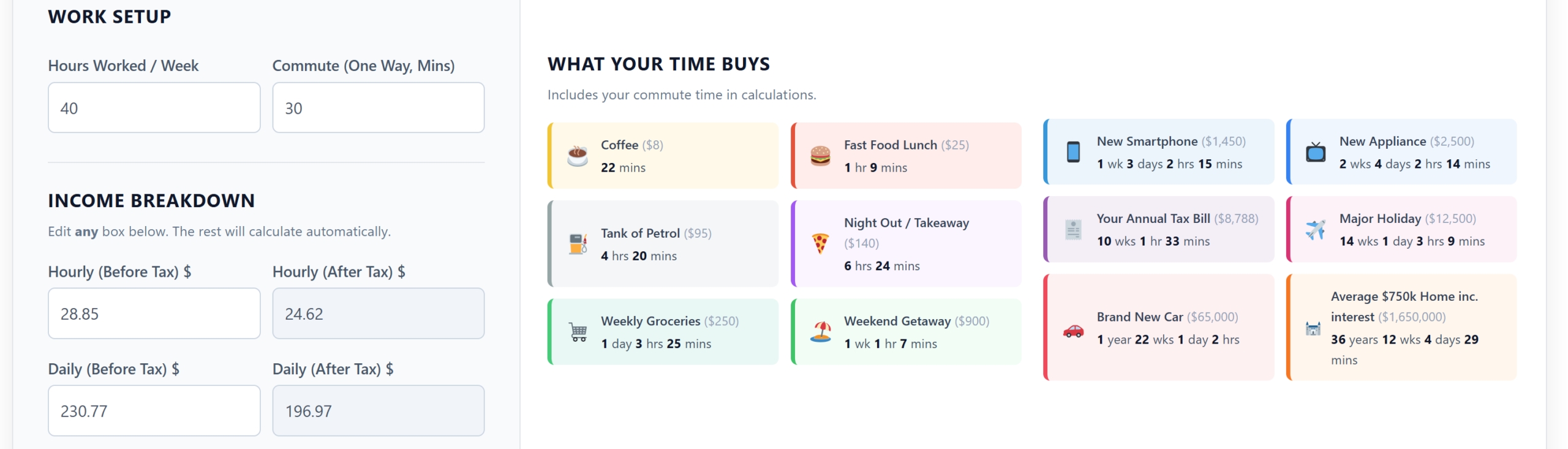
- The New Car Trap: Dropping $65,000 on a brand new ute or SUV is incredibly common in Australia. But when you factor in your after-tax income, you might be trading an entire year and a half of your life—waking up, commuting, grinding away—just to pay for the metal box that gets you to the job.
- The Smartphone Upgrade: Upgrading to the latest $1,450 phone every two years feels standard. But realizing you have to hand over nearly a full week of your life just to scroll social media on a slightly better camera forces you to ask if your current phone is really that bad.
- The “Harmless” Takeaway: A $25 burger and chips for lunch on a Tuesday seems harmless. But realizing that you spent the first full hour of your workday just to pay for a lunch that you ate in 15 minutes at your desk makes packing a sandwich feel like a brilliant financial strategy.
Visualising the trade-off: is the convenience worth the hours of your life?
This Isn’t About Never Spending Again
It’s important to clarify something: the point of this tool is not to make you feel guilty for buying a coffee, and it isn’t designed to turn you into an extreme tightarse who never leaves the house. You work hard, and you deserve to enjoy the fruits of your labour.
The goal is simply intentionality. Money is a renewable resource; you can always earn more of it. Time, however, is strictly non-renewable. Every hour you spend working is an hour you can never get back. When you view your spending through the lens of time, you naturally start filtering out the mindless purchases that don’t actually bring you joy.
If you run the numbers and see that a $900 weekend getaway with your partner costs you three days of work, you might think, “Absolutely, that memory is 100% worth three days of my time.” But when you see that buying lunch out every day costs you an entire month of your working year, you might reconsider.
Take the “Time Test”
Before you make your next major purchase, or before you tap your card out of pure convenience, I challenge you to run the numbers. Put your actual salary, your work hours, and your commute time into the calculator. Search for the item you want to buy in the custom field.
Look at the days, hours, and minutes staring back at you and ask yourself the only question that matters: Am I willing to trade this much of my life for this item?
Calculate Your True Earning Power
Use the free Money is Time Calculator right here on this page, or explore our other unbiased financial tools on ClearCents.au.
Explore More ClearCents Tools