When I signed the papers for my first home, I felt a mix of immense pride and quiet dread. Like most first-time buyers, I walked into the process knowing very little about how mortgages actually function beneath the glossy marketing brochures. I trusted the bank, accepted the standard 30-year term as an unchangeable law of nature, and assumed that whatever monthly repayment the lender spat out was simply the price of admission to homeownership.
It wasn’t until years later—after rolling up my sleeves, staring down the raw amortisation schedules, and building the Home Loan Calculator on ClearCents.au—that I realized how much control we actually surrender when we don’t understand the maths. Mortgages aren’t static contracts written in stone; they are dynamic, fluid equations. Once you start testing different variables, you realize you can hack the system to shave years off your loan and save tens of thousands of dollars in interest.
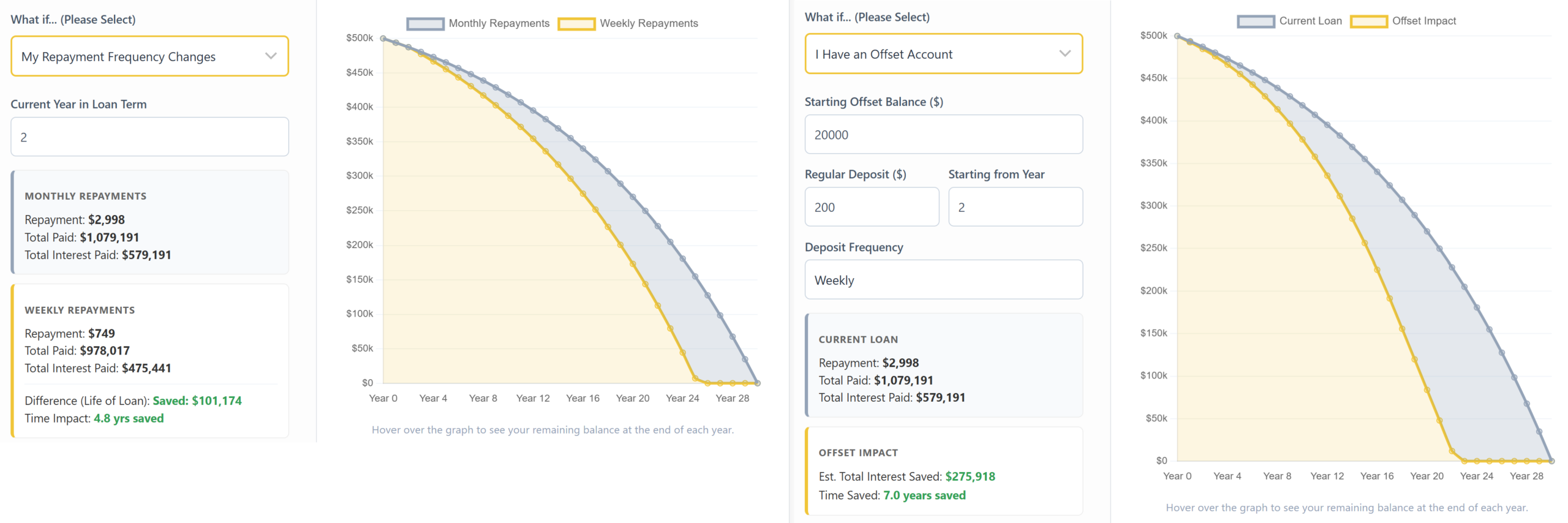
The ClearCents Home Loan Calculator: designed to test variables without bank bias.
The Six “What-If” Scenarios That Changed Everything
To really master your mortgage, you cannot just look at your base repayment. You have to understand how subtle shifts ripple across decades. That is why I built the advanced options directly into the ClearCents calculator, allowing anyone to toggle between six critical scenarios:
1. What if my interest rate changed?
In an economic climate where rates fluctuate unpredictably, stress-testing your budget is non-negotiable. This option lets you instantly see what a 0.5% or 1% rate hike does to your monthly outflow, letting you build a buffer before reality forces your hand.
2. What if I changed my repayment frequency?
This was one of my first major eye-openers. Switching from monthly to fortnightly (or weekly) repayments tricks your budget in the best way possible, resulting in an extra full month’s payment paid down every single year without feeling the pinch.
3. What if I refinanced my loan?
Refinancing sounds like a magic bullet for lower payments, but it carries a hidden trap that caught me out early on (more on that below). This calculator lets you see past the shiny introductory rate to look at the true lifetime cost.
4. What if I had an offset account?
A transaction account linked directly to your mortgage that reduces the principal balance on which interest is calculated. Seeing how every dollar sitting in here actively eats away at your daily interest charges is staggering.
5. What if I made extra repayments?
Even an extra $50 or $100 a week injected into your regular payments alters the compound interest curve dramatically, shaving years off your mortgage timeline.
6. What if I made lump sum payments?
Tax returns, work bonuses, or unexpected cash windfalls don’t need to vanish into lifestyle inflation. Dropping a lump sum directly into the loan changes your trajectory overnight.
The Weekly Repayment Revelation
When I first learned about changing repayment frequencies, I was genuinely surprised by how such a minor structural tweak could yield massive results. Most people pay their mortgage monthly because that’s how salaries or default bank setups occur. But there are 12 months in a year, yet 52 weeks (or 26 fortnights).
If your monthly payment is $2,000, your annual layout is $24,000. However, if you switch to paying half of that ($1,000) every fortnight, you end up making 26 fortnightly payments a year. That equals 13 full monthly payments instead of 12. You haven’t budgeted an extra painful lump sum; you’ve simply realigned your cash flow with how you get paid. Running this through the calculator showed me how that single adjustment effortlessly slices years off a 30-year loan.
The Offset Account Powerhouse
Another monumental shift in my mortgage journey was utilizing an offset account. Traditional savings accounts pay you a bit of interest, which is then taxed. An offset account works differently: every dollar sitting in that account offsets the principal balance of your mortgage dollar-for-dollar when the bank calculates daily interest.
If you owe $500,000 on your home, but you have $40,000 sitting in an offset account, the bank only charges you interest on $460,000. Because interest calculates daily, keeping your emergency fund, your upcoming bills money, and your pay parked in an offset account saves you real money every single day. Seeing that visualization on the calculator completely transformed how I handled short-term cash flow.
The Refinancing Trap: A Lesson Learned the Hard Way
Not all lessons come easy, and my experience with refinancing taught me a sobering reality about how banks package products. Previously, I decided to refinance my home loan. The broker and the bank sold it brilliantly: “Look at your new lower monthly repayments! You’re going to save money right now!”
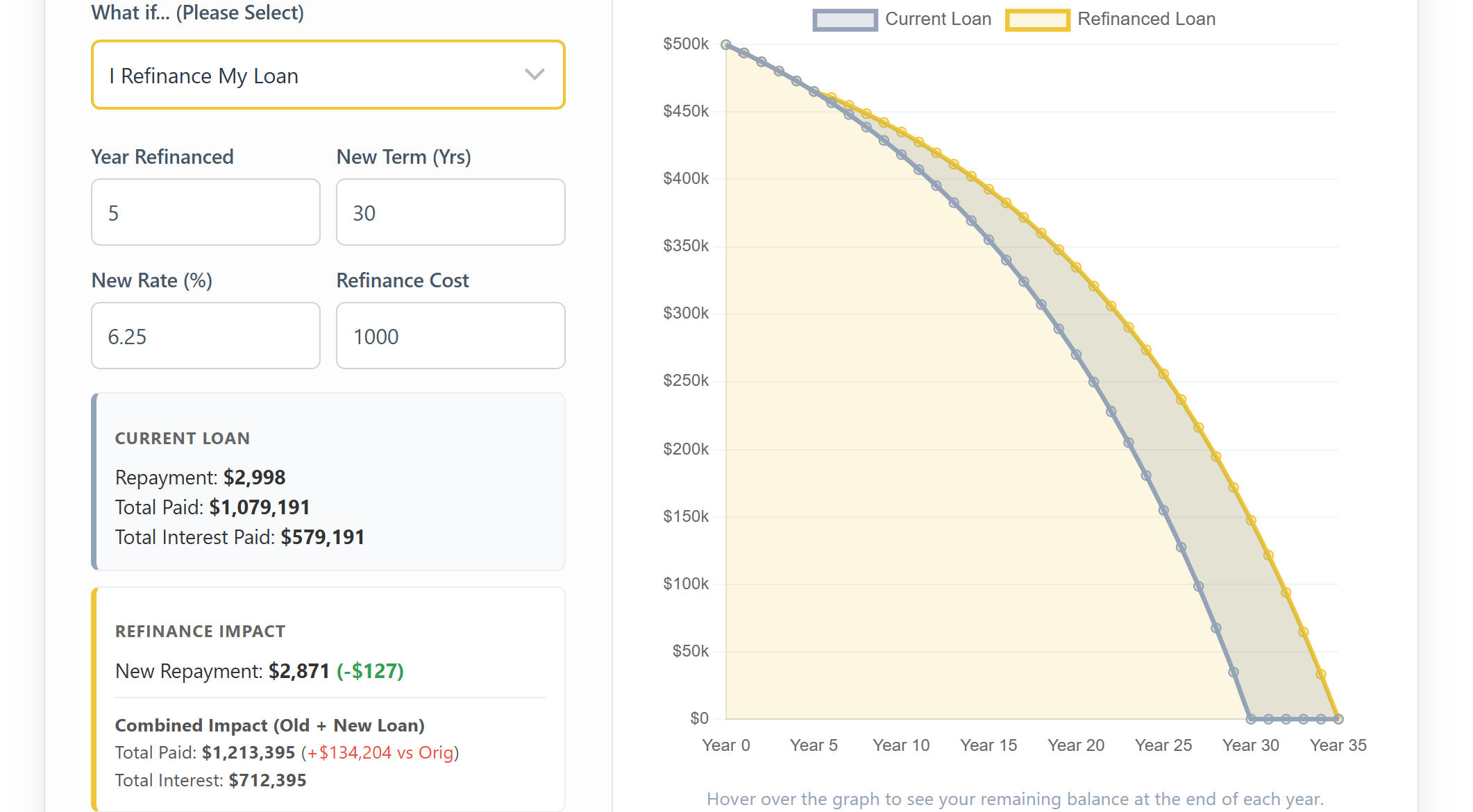
Caught up in the relief of a lower monthly bill, I didn’t look closely enough at the fine print. By refinancing, I had inadvertently signed up for a brand-new 30-year term. Because I was several years into my original mortgage, resetting the clock back to 30 years added a significant amount of time to my overall debt timeline.
When you calculate the total amount repaid—taking into account the original years paid plus the brand-new 30-year term—the total interest paid over both loans was drastically higher than if I had just stuck to my original loan and maintained a slightly higher repayment structure. A lower monthly repayment felt great in the short term, but it extended my debt bondage and cost me heavily in the long run. Building the refinancing calculator scenario into ClearCents was my way of ensuring other people can see right through that marketing illusion before signing on the dotted line.
Comparing scenarios: seeing the true lifetime cost of resetting loan terms vs. optimizing extra repayments.
Taking Back Control of Your Mortgage
Your mortgage is likely the largest financial commitment of your life, which makes it prime territory for financial institutions to obscure the true costs behind complex jargon. You don’t need an accounting degree or a slick broker to figure out how to beat the curve. You just need clear tools, maths, and the willingness to test different scenarios.
Whether it’s shifting to weekly payments, maximizing an offset account, or evaluating whether a refinance is actually a step forward or a 30-year trap, running your own numbers gives you the clarity you need. ClearCents was built to put that power back into your hands—free, unbiased, and completely transparent.
Run Your Own Mortgage Scenarios
Curious how much time and interest you can save with weekly payments or an offset account? Test the numbers on ClearCents today.
Explore ClearCents Calculators